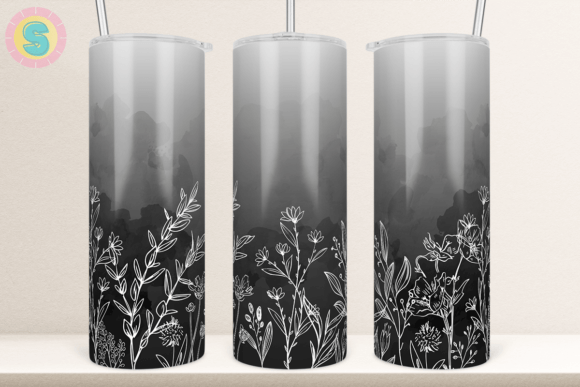
Wild Flower Ombre Black Tumbler Wrap
A Designer’s First Look: Soft, Flowing, and Quietly Confident
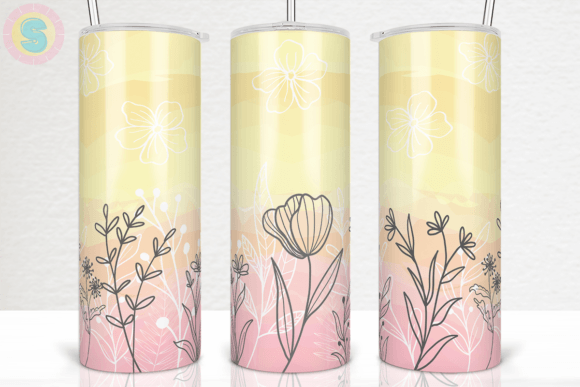
When Wild Flower Ombre Black Tumbler Wrap landed in my inbox, I paused—not because it screamed for attention, but because it *breathed*. It’s a watercolor-inspired floral wrap built for sublimation, yes—but as an embroidery designer who regularly adapts graphics for stitch, I immediately saw its quiet potential beyond tumblers. The ombre fade from deep charcoal to soft black creates dimension without contrast overload; the wildflower cluster feels loose and organic, not rigid or over-arranged. There’s no hard outline, no tight symmetry—just gentle movement, layered petals, and subtle negative space that invites interpretation. That’s rare in digital embroidery assets, especially in the Crafts category where many floral designs lean too literal or overly dense.
Real Project Test: Turning It Into a Handmade Tote Bag for a Local Boutique
Last week, I used Wild Flower Ombre Black Tumbler Wrap as the foundation for a custom embroidered tote bag—intended for a small botanical-themed gift shop. I didn’t treat it as a tumbler graphic repurposed on fabric. Instead, I reimagined its flow: scaled it down 30%, simplified one overlapping stem using a running stitch path, and added a light satin-stitched border around the outer bloom cluster to anchor it on the canvas. Why? Because the original layout assumes a curved, cylindrical surface—and flat fabric needs visual weight distribution. On natural linen-cotton blend, the design translated beautifully: soft but legible, delicate but durable. Customers commented on how “calm” and “thoughtful” it felt—not just pretty, but intentional. That’s the difference between a decoration and a signature detail.
Where It Shines (and Where It Needs Care)
Wild Flower Ombre Black Tumbler Wrap works best when you honor its mood—not force it into high-contrast, high-detail roles. It excels on:
- Sweatshirt embroidery — especially midweight fleece or French terry, where the ombre depth reads as rich texture, not flat gray
- Embroidered patches — stitched onto denim jackets or canvas aprons, where its fluid edges soften the rigidity of the base fabric
- Baby embroidery — on organic cotton onesies or burp cloths, where subtlety reads as tenderness, not lack of impact
- Holiday embroidery — think minimalist Christmas tea towels or neutral-toned nursery pillows where tradition meets modern restraint
- Commercial embroidery for boutique branding — it pairs well with clean sans-serif logotypes and doesn’t compete for attention
But proceed thoughtfully on:
- Stretchy or thin fabric — the watercolor softness can blur if stabilizer isn’t matched precisely to knit tension or gauze weight
- Curved surfaces like caps — the wrap’s horizontal rhythm doesn’t adapt naturally to crown curvature; consider isolating a single bloom instead
- Dense fill-stitch areas — avoid stitching the full cluster at under 3" wide; small hoops may lose petal definition or create thread buildup
- Dark fabric without contrast testing — since it’s built in black-to-charcoal tones, test thread colors against your base fabric—even black thread can look muddy on true black twill
What It Adds to Your Finished Product—Beyond Aesthetics
Using Wild Flower Ombre Black Tumbler Wrap thoughtfully elevates perceived value. It signals care—not just in execution, but in curation. Customers don’t buy “a floral design”; they buy a feeling of grounded elegance. For Etsy sellers and craft fair vendors, that translates directly to higher engagement: longer page views, more saved listings, fewer returns due to mismatched expectations. Its seamless nature means no awkward seams on round items—or on folded pillow covers where alignment matters. And because it avoids trendy motifs (no monograms, no slogans), it stays relevant across seasons and customer demographics.
Practical Embroidery Designer Notes Before You Stitch
This isn’t a plug-and-play machine embroidery design—it’s a digital embroidery file asking for collaboration. Before committing thread and time:
- Test on scrap fabric first — especially if using textured weaves or eco-dyes that shift color response
- Check stitch density visually — zoom into the PNG preview; if inner petals read as solid blobs rather than layered forms, reduce fill density by 10–15%
- Confirm hoop size compatibility — the full wrap likely exceeds standard 4x4 hoops; plan for re-hooping or cropping key elements
- Inspect small details in grayscale — convert your mockup to black and white to verify petal separation and stem clarity
- Compare light vs. dark backgrounds — what reads as soft ombre on white may vanish on charcoal; adjust thread values accordingly
- Use cutaway + tearaway stabilizer combo — the design’s fluid lines need support without stiffness, especially on drapey fabrics
- Verify licensing for commercial embroidery — since Wild Flower Ombre Black Tumbler Wrap is listed as a Graphics product, confirm whether finished embroidered goods or resale of adapted files are permitted
Final Thought: A Design That Listens Back
Wild Flower Ombre Black Tumbler Wrap doesn’t dominate a project—it settles into it. As a designer, I appreciate that. It leaves room for craftsmanship to speak: the choice of matte vs. glossy thread, the tension balance on a curved seam, the way light catches a satin-stitched stamen at dusk. It’s not flashy. It won’t trend on TikTok overnight. But it builds trust—one handmade product, one personalized gift, one small shop shelf at a time. If your craft business values authenticity over algorithm, this is the kind of design asset that quietly compounds goodwill. Just remember: let it breathe. Don’t over-stitch it. Don’t over-explain it. Let the wildflowers do their quiet work.