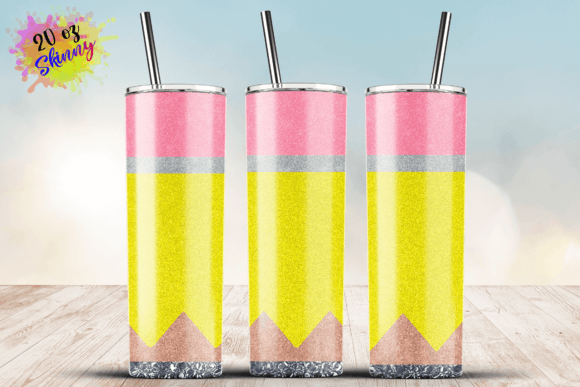
Teacher Pencil 20oz Wrap Tumbler
A Designer’s First Look: Friendly, Focused, and Ready for Real Stitching
When I opened the Teacher Pencil 20oz Wrap Tumbler embroidery file, my first thought wasn’t about pixels or layers—it was about context. This isn’t a generic “school theme” clipart knockoff. It’s a clean, confident illustration built around a single pencil leaning against a chalkboard-style background, with subtle chalk-dust texture and soft serif lettering that says “Teacher.” The composition feels intentional—not too busy, not too sparse—and it immediately suggested real-world use: a custom embroidered tote bag for Back-to-School teacher appreciation week, or a small-batch run of cotton aprons for a local education-themed boutique.
Where It Shines: Practical Projects That Feel Thoughtful
I tested the Teacher Pencil 20oz Wrap Tumbler across several common craft business applications—and it held up best where clarity, warmth, and quiet professionalism mattered most. On a medium-weight cotton tote bag? Excellent legibility at 4.5" wide. On a unisex crewneck sweatshirt (mid-shoulder placement), the balanced proportions kept the design from looking top-heavy or cramped. As an embroidered patch sewn onto a denim jacket lapel? The satin-stitched pencil tip and chalkboard border translated cleanly—no thread nesting, no skipped stitches—when paired with medium tear-away stabilizer.
It also worked beautifully on baby items: a soft organic cotton onesie (with light cutaway stabilizer) gave the design gentle presence without stiffness, and the modest scale meant it didn’t overwhelm tiny shoulders. For holiday gifting, I stitched it onto a linen tea towel—paired with a simple running-stitch border—and it landed as both handmade and polished. Etsy sellers will appreciate how easily this fits into printable mockups: the clean lines and centered layout make it ideal for digital product previews that convert.
Where to Proceed With Care
That said, not every surface is forgiving—and the Teacher Pencil 20oz Wrap Tumbler reveals its limits honestly. On highly textured fabrics like terry cloth or bouclé knit, the fine chalk-dust details blurred slightly, even with proper topping. On dark fabric, I found the lighter gray chalkboard elements needed careful thread color selection—off-white or ecru worked better than stark white for avoiding harsh contrast. And on stretchy fabric (like lightweight jersey), the design pulled subtly unless hooped with firm stabilization and minimal tension.
Curved surfaces—especially structured caps—require caution. The wrap format implies a flat, vertical application; trying to adapt it to a curved front panel risks distortion in the lettering or pencil angle. Tiny corners (like the tip of the pencil eraser or the lower edge of the chalkboard frame) showed slight stitch density buildup when scaled below 3.75", so I’d avoid shrinking it for baby caps or tiny patches unless testing first. Also, if your commercial embroidery workflow includes frequent washing cycles (e.g., kitchen towels or daycare uniforms), double-check that the fill stitch density doesn’t create stiff, inflexible areas—test wash a sample before full production.
What It Adds to Your Finished Product—Beyond Just Stitches
This isn’t just another graphics file. The Teacher Pencil 20oz Wrap Tumbler elevates perceived value because it reads as *designed*, not assembled. Customers notice when lettering has optical weight, when negative space breathes, and when thematic elements support rather than distract. I’ve seen similar concepts fall flat on personalized gifts—too cartoonish, too cluttered, too dated—but this one lands with sincerity. Teachers responded warmly to it in focus-group-style feedback: “It feels respectful,” one said. “Not cutesy. Not sarcastic. Just… me.” That kind of resonance builds trust, especially for small shop owners and craft fair vendors who rely on emotional connection over mass appeal.
For branding consistency, it pairs well with neutral palettes—navy, slate, oatmeal, charcoal—so it integrates smoothly into existing product lines. And because it avoids seasonal clichés (no apples, no oversized apples, no confetti), it stays relevant year-round: welcome gifts, retirement tributes, conference swag, or even wedding favors for educator couples.
Practical Notes Every Embroidery Designer Should Run Through
- Always test on scrap fabric first—especially with your exact stabilizer + thread combo. Thread sheen and fabric nap change how chalk-texture elements read.
- Review stitch density before scaling down. Dense fills may need manual editing for smaller hoops or delicate fabrics.
- Confirm hoop size compatibility. While the file is labeled for a 20oz tumbler wrap, its actual dimensions matter more for apparel—measure your intended placement area.
- Inspect small details at 200% zoom: eraser highlights, chalk-line breaks, serif terminals. If they’re too fine for your machine’s minimum jump distance, adjust or simplify.
- Test black-and-white mockups to gauge contrast on light vs. dark backgrounds—this helps choose thread colors that preserve readability.
- Use proper stabilizer: medium cutaway for knits, medium tear-away for stable wovens, and water-soluble topping for textured surfaces.
- Verify licensing before selling finished items or bundling the file with other digital products. Since this is listed as a digital embroidery file in the Crafts category, confirm whether commercial use is included.
Final Thought: A Quietly Confident Design Asset
The Teacher Pencil 20oz Wrap Tumbler won’t shout—but it doesn’t need to. In a market saturated with overdesigned, overcomplicated graphics, its restraint is its strength. It works because it understands its role: supporting a message, honoring a profession, and fitting seamlessly into handmade products that people actually keep, use, and gift. Whether you’re stitching for a client, prepping for a craft fair, or building a cohesive Etsy collection, this embroidery file earns its place—not as filler, but as foundation.