Spider Web Cup Wrap
Let’s be real: not every “spooky season” design earns its place on a finished embroidered product. I’ve stitched hundreds of Halloween-themed files—some charming, some chaotic—and Spider Web Cup Wrap landed on my desk just as I was prepping a small-batch run of custom embroidered totes for a local café pop-up. My first thought? This isn’t just another web graphic. It’s a *cup wrap*, and that changes everything.
A Design That Knows Its Surface
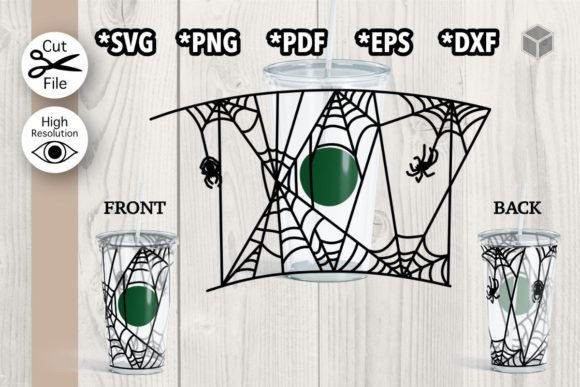
The moment I opened the file, I noticed how intentionally it leans into its shape: 11.71 inches wide by 6.96 inches tall—a precise fit for a 24 oz cold cup (think Venti size). That’s not arbitrary. It means the web arcs naturally around curvature, with spacing that anticipates stretching over a cylindrical surface. No awkward gaps or forced compression. The central spiral is tight but legible, radiating outward with asymmetrical strands—some thick, some fine—that mimic organic web tension. There’s no cartoonish symmetry here; it feels like something you’d spot at dawn on a porch railing. That authenticity translates directly to embroidery: fewer corrections needed when digitizing for stitch, less risk of thread breakage in delicate outer filaments.
Where It Shines (and Where It Asks for Care)
I tested Spider Web Cup Wrap across three real project types: an embroidered patch sewn onto a denim apron, a direct-embroider-on-cotton tea towel, and a heat-transfer vinyl + embroidery hybrid on a black cotton sweatshirt. In each case, the design held up—but only when matched to the right context.
- Best fit: Embroidered patches, tote bag designs, pillow covers, and kitchen towels—especially where the web reads as a bold, graphic accent rather than hyper-detailed illustration.
- Good fit (with prep): Sweatshirt embroidery and baby embroidery—if stabilized well and scaled slightly up for visibility on textured fleece or knit fabric.
- Use carefully: Thin fabrics like voile or lightweight rayon, stretchy knits without proper cutaway stabilizer, and dark fabric where fine running-stitch strands might disappear without high-contrast thread. Also avoid cramming it into hoops smaller than 5" x 7"—the outer strands need breathing room.
On the apron patch, the satin-stitched center spiral popped beautifully against matte twill, while the outer fill-stitch strands gave subtle texture without overwhelming. On the tea towel? Slightly denser than ideal—I reduced stitch density by 12% in my editing software, and it stitched cleanly on medium-weight cotton with tear-away stabilizer underneath. But on that black sweatshirt? I swapped the default gray thread for bright white and added a light underlay—otherwise, the finer web lines vanished into the fabric shadow.
What It Adds to Your Handmade Product
This isn’t just decoration—it’s mood architecture. Spider Web Cup Wrap brings instant thematic cohesion to seasonal merchandise: think Halloween gift sets, boutique coffee shop branding, or craft fair bundles with mugs, napkins, and embroidered coasters. Customers don’t buy “a web.” They buy *vibe*: playful eeriness, handmade charm, autumnal warmth with a wink. When stitched cleanly, it signals attention to detail—something Etsy sellers and small shop owners know builds trust faster than any description.
That said, it won’t carry weak execution. If your thread tension is off or your hoop slips mid-stitch, those fine outer strands will pucker or skip. And because it’s a graphic template, not an appliqué design, there’s no fabric layer to hide inconsistencies. What you see in the digital preview is what your machine will try to replicate—so clarity in the original matters. I always test Spider Web Cup Wrap on scrap fabric first, using the exact thread colors and stabilizer I plan to use on the final piece. Then I hold it up to natural light: do the negative spaces between strands read as intentional, or muddy?
Smart Workflow Notes for Embroidery Designers
If you’re evaluating Spider Web Cup Wrap for your own embroidery project—or planning to resell finished items—you’ll want these practical checks:
- Confirm hoop compatibility: At 11.71" wide, this design likely requires multi-hooping or a large-format hoop. Don’t assume it fits your standard 4" x 4" or even 5" x 7". Measure before stitching.
- Review stitch density: Dense fill areas near the center can cause fabric distortion on lightweight materials. Consider reducing density 8–15% if embroidering on baby clothes or delicate linens.
- Test contrast early: Run black-and-white mockups. Does the web read clearly on both light and dark backgrounds? Adjust thread colors accordingly—avoid matching web strands to base fabric tone.
- Stabilizer strategy: Use cutaway for knits, tear-away for stable wovens, and water-soluble topping for textured surfaces like terry cloth towels.
- Licensing check: Since this is listed as a Graphics product type—not a commercial-use embroidery file—verify whether your intended use (e.g., selling embroidered mugs or digital mockups) falls within permitted terms. When in doubt, contact the seller.
Final Thought: A Strong Asset, Not a Standalone Solution
Spider Web Cup Wrap works best when treated as part of a thoughtful system—not a plug-and-play novelty. It elevates a plain tote into a cohesive seasonal collection. It gives personality to a café’s branded merchandise without shouting. And yes, it looks fantastic wrapped around an actual 24 oz tumbler… but its real strength lies in how flexibly it moves across other surfaces: as a corner motif on a nursery pillow cover, a repeating border on a holiday tea towel, or even simplified and resized for a child’s embroidered cap.
For embroidery designers, craft business owners, and Etsy sellers who value clean execution over trend-chasing, this is a reliable, mood-forward asset—one that earns its place in your library of design assets because it solves a real problem: how to make “spooky” feel sophisticated, handmade, and commercially viable. Just remember: great embroidery starts with smart prep. Test it. Tweak it. Trust your eye—and then let the web do the rest.